Ultra-processed foods - How it all began
Ultra-processed foods (UPF) - Part1
High consumption of ultra-processed foods is associated with an increased risk of chronic diseases, including obesity, type 2 diabetes, cardiovascular and cerebrovascular diseases, hypertension, dyslipidemia (an imbalance in cholesterol and/or triglycerides), as well as certain cancers, depressive symptoms, cognitive disorders, sleep disturbances, and higher overall mortality rate.
For centuries, food was prepared in a kitchen from simple ingredients. It was minimally processed when needed to conserve it, like salting the meat to preserve it, canning fruits and vegetables to have food through the winter, etc. The final product was still an identifiable food product.
Nowadays, walking through a grocery store gives you a totally different view: artificial colours, flavours, long ingredient lists, unknown ingredients, standardized, perfect shapes, colours and sizes. All a result of a complex, industrial process that is hard to reproduce at home and the end result is lacking nutritional value, just empty, useless calories with harmful consequences.
In some countries, UPFs make up of 60 - 70 % of the calories consumed by the population, including children and adolescents, like in the US, United Kingdom. In France, Canada, or Australia, this figure is around 50%. Even in Italy or Brazil, where exposure is lower, it exceeds 25% .
How did we get here and what are the health consequences? How can we learn to identify UPFs in order to limit their presence in our diet?
With industrial growth more people were working longer hours, more women entered the workforce with less and less time spent in the kitchen, so the food adapted to their needs.
Here’s how it all started ….
At the end of the 19th century, food processing and preservation spread among the civilian population. At this time big food companies were born: Nestle, Maggi, Coca-Cola, Campbell, etc.
Food processing was no longer only about preserving: it made it possible to feed increasingly large urban populations, with foods that were easy to distribute and cheaper to produce.
It was during this period that the industry began to use synthetic substances. Certain dyes, notably derived from coal and sometimes highly toxic, were used to improve the appearance of products and mask their poor quality. These practices quickly led to widespread misuse, to the point that the United States adopted the Food and Drugs Act in 1906, one of the first laws regulating the use of food additives, in order to control the use of these dyes.
The 2 World Wars accelerated this process, easily feeding a large population with cheap, non-perishable processed food and when the wars ended, it got moved toward the civilian population.
Toward the end of the 19th century the boom of ultra-processed foods has started. Not only the meals were processed, but agricultur started to get highly industrialized. Thanks to the massive use of chemical fertilizers and pesticides, the production of certain crops exploded. Corn, wheat, and soy became the pillars of an intensive agricultural system, capable of producing in very large quantities, at low cost.
This overproduction pushed the industry to change its logic: rather than transforming agricultural products as a whole, it began to “break them down” to extract inexpensive components that are easy to store and combine: sugars, oils, starches, proteins. Thus, wheat is no longer only ground into flour: it is also fractionated into industrial ingredients such as starch or maltodextrin, used to give texture to products. At the same time, corn becomes a central raw material for producing industrial sugars, notably glucose syrup, which gradually replaces sugar in many products.
In the early 2000s the term of Ultra-Processed Food (UPF) was introduced by Brazilian researcher Carlos Monteiro. Until then, foods were mainly evaluated based on their nutritional composition: sugar content, salt, fat, protein . Carlos Monteiro and his team proposed a new approach: classifying foods according to their degree of processing. This led to the NOVA classification.
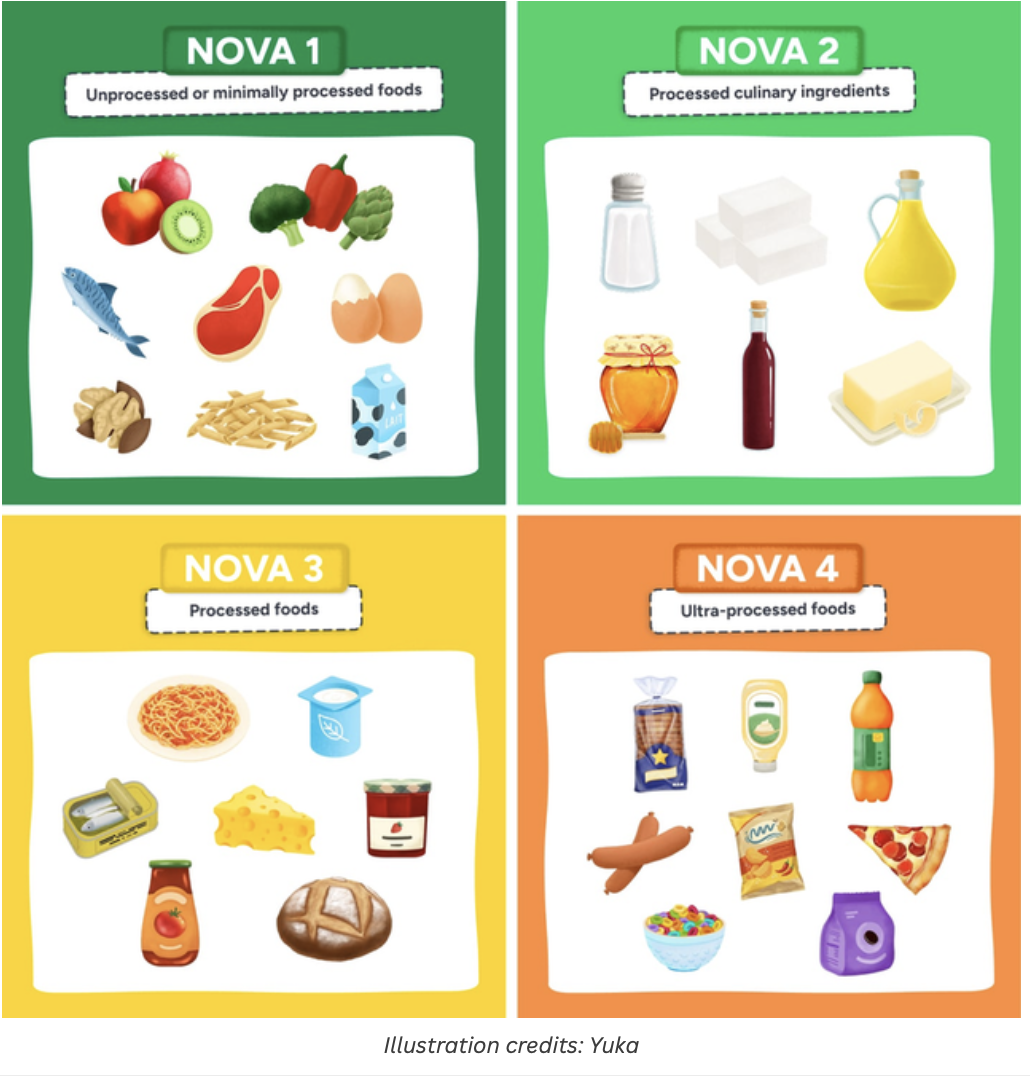
The NOVA approach raises some difficulty. In most cases, the industrial processes used to manufacture a product are not indicated on the product .
In 2019, the Food and Agriculture Organization of the United Nations (FAO) proposes another approach to identifying UPF: rather than relying on manufacturing processes, use the ingredient list, which is mandatory on all packagedproducts as an indicator.
Certain ingredients and additives are characteristic of UPF according to the FAO:
Industrial ingredients: these are ingredients that are not found in a typical kitchen. They are intentionally added to products to modify their structure and lower the cost of production. Examples include hydrogenated oils, hydrolyzed proteins, mechanically separated meats, modified starches, sugar syrups, etc.
“Cosmetic” food additives: UPF generally contain several additives that serve to improve appearance, intensify taste, or provide a pleasant texture. They act on perceptions - visual and sensory - like makeup, that gives the illusion of a real food. Among the most common are artificial colorants, sweeteners such as aspartame or sucralose, texture agents such as mono- and diglycerides or certain gums, flavour enhancers such as monosodium glutamate, as well as flavours.
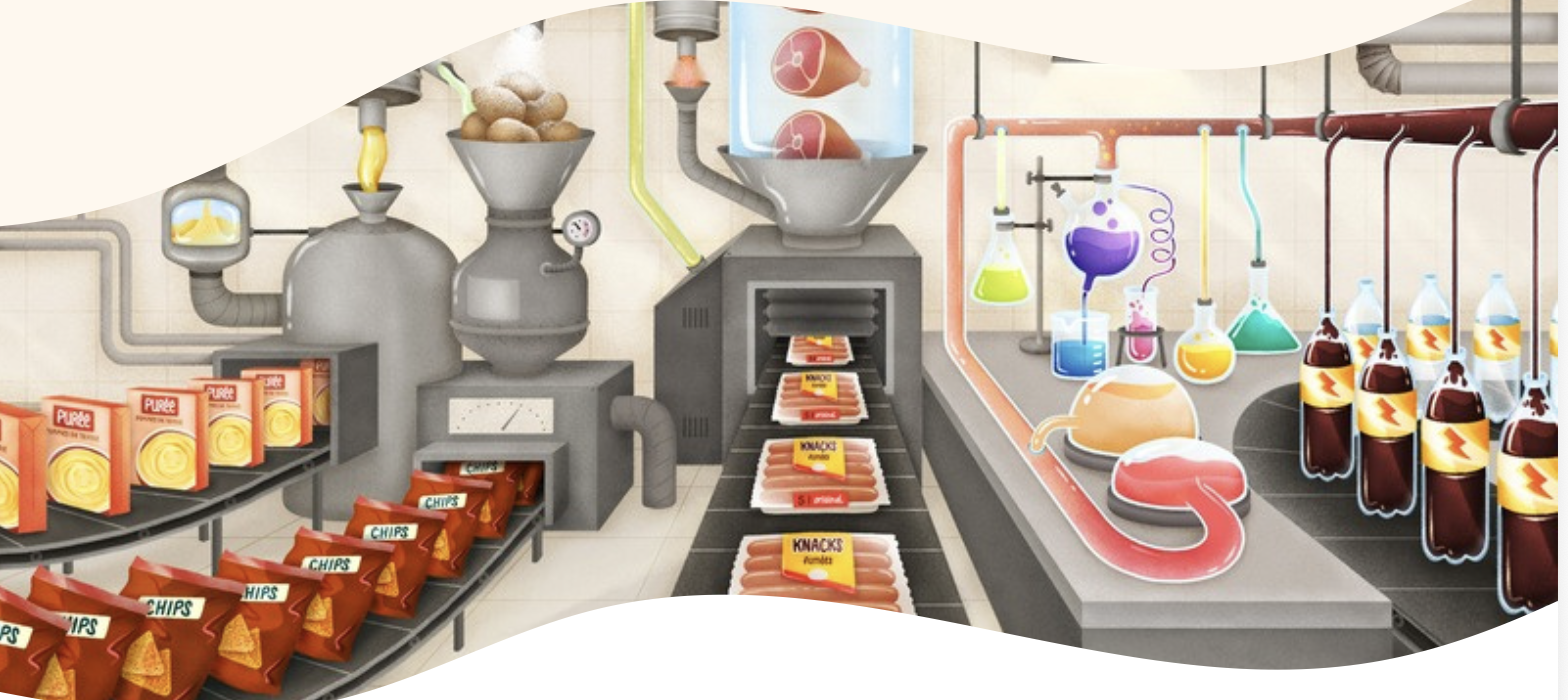
Let’s take a look at how the food industry manufactures these products: by deconstructing, then reconstructing.
Unlike a homemade dish, where whole ingredients are combined, ultra-processed foods result from a multi-step industrial process that first breaks down the food’s natural structure before artificially reassembling it.
Low-cost raw materials, often derived from large monocultures that are heavily subsidized (corn, wheat, soy, peas, etc.) or from by-products of other sectors (lower-quality cuts of meat, whey from the dairy industry, etc.) are processed to extract their different components by separating proteins, sugars, fibers or fats. This step makes it possible to obtain standardized ingredients: powders, oils, or syrups, often colourless and sometimes almost tasteless.
Once the components are separated, they must be given form again. So the reconstruction begins.
These powders, oils, syrups no longer have the appearance or texture of a food: they must therefore be reassembled to become a consumable, stable product: a sauce that does not separate, a cream that always remains smooth, a biscuit identical from one batch to another.
It is at this stage that additives come into play. Texturizing agents are added to provide softness or crispness. Emulsifiers are used to create a creamy texture. Colorants add an attractive shade. Flavorings are used to recreate the taste of a fruit, meat, or another ingredient that may not actually be present in the product . The preparation can then be shaped using industrial processes such as extrusion cooking. This technique consists of subjecting the material to high pressure and high temperature, then passing it through a mold that gives it its final shape. Under the combined effect of heat and pressure, the texture is deeply modified: the material can become airy and crispy. This is how many breakfast cereals or certain puffed snack products are made.
At the end of this stage, it is no longer simply a processed food, but an industrially constructed product.
UPFs are manufactured to be irresistible.
Here’s how:
by maximizing the pleasure experienced during consumption. One of the key notions in this field is the “bliss point”- a concept developed by the American psychologist Howard Moskowitz, trained at Harvard, specializing in the study of taste, showing that pleasure increases with the quantity of sugar and then decreases when the concentration becomes too high. These results are also valid for the quantity of salt or fat: there exists a precise level at which taste is judged “just right” and that is the “bliss point”
new methods from neuroscience were used to directly analyze the brain’s reactions to food. This research shows that certain foods strongly activate brain circuits linked to reward. This is particularly the case for products rich in sugar and fat, which stimulate the release of dopamine, a neurotransmitter associated with the sensation of pleasure. This knowledge is progressively integrated into the design of food products. Manufacturers seek to reproduce the sensory characteristics that trigger the strongest pleasure responses . Researchers then begin referring to “hyper-palatable” foods: products designed to provoke a particularly intense response from the reward system. These foods are designed to offer a multi-sensory experience: taste, texture, smell, or appearance are carefully engineered in order to make the consumption experience rewarding .
The foods that activate these circuits often combine high amounts of sugar and fat, a combination rarely found in natural foods. For example, fruits are rich in carbohydrates but low in fat, while salmon or nuts are rich in fat but low in carbohydrates.
This combination of sugar and fat can amplify the reward response and encourage repeated consumption .
hyper-palatable foods may mimic certain mechanisms of addiction: by activating the same brain reward circuits as certain drugs,
they could promote compulsive consumption behaviours due to the high concentration of ingredients that are highly rewarding for the
brain, and their particularly rapid absorption by the body.
To study this phenomenon, scientists have developed a scale called the Yale Food Addiction Scale, aimed at
identifying addictive behaviours related to food. An analysis combining more than 280 studies based on this scale estimates that around 14% of adults and 12% of children show signs of food addiction linked to the consumption of ultra-processed foods.
Over the past decade, a growing number of scientific studies have established a link between high consumption of ultra-processed foods and an increased risk of numerous chronic diseases: obesity, type 2 diabetes, cardiovascular and cerebrovascular diseases, hypertension, dyslipidemia (an imbalance in cholesterol and/or triglycerides), as well as certain cancers and higher overall mortality rate. Studies also suggest a link with certain mental health disorders, such as depressive symptoms or cognitive impairments, sleep disturbances.
For a long time, these effects were attributed solely to their poor nutritional composition: too much sugar, salt, or fat. However, recent research suggests a more complex reality. Several studies show that the negative effects of ultra-processed foods persist even when calorie intake and nutritional content are comparable, suggesting that the issue is not limited to nutrients alone, but also relates to the very nature of these products and the processes used to manufacture them.
There is now strong evidence for several major health risks associated to UPF consumption.
Cardiovascular risk is among the most well-documented effects. An increase of just 10% in the proportion of ultra-processed foods in the diet is associated with :
+12% risk of overall cancer
+11% risk of breast cancer
+15% risk of type 2 diabetes
+11% risk of overweight
+9% risk of obesity
The 2024 umbrella review analyzed data from 9.9 million individuals across 14 independent, high-quality studies. It identified direct associations between the consumption of ultra-processed foods and an increased risk of 32 health outcomes. The researchers then identified the associations supported by the highest levels of evidence:
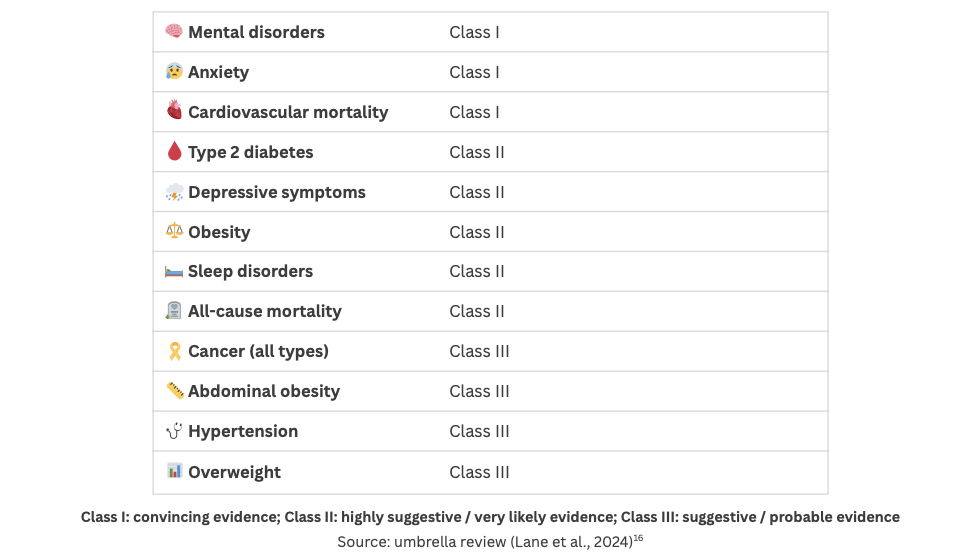
Image credit: Yuka
There are other concerning effects under investigation, the evidence is still being consolidated, but the findings arevsufficiently concerning to warrant attention. This is notably the case for gut health, reproduction, and liver health.
Gut health
Ultra-processed foods are particularly harmful to the gut microbiota, the community of billions of microorganisms that play a central role in health. This is due both to their unfavourable nutritional profile and to the presence of numerous additives that can disrupt the composition and balance of this fragile ecosystem .
This unfavourable nutritional profile, characterized by low levels of fiber and bioactive compounds, and a high content of rapidly absorbable nutrients, hinders the growth of beneficial gut bacteria while promoting less favourable species. Gradually, an imbalance in the microbiota develops: this is what is known as dysbiosis .
There can be multiple consequences. Metabolically, dysbiosis can disrupt insulin regulation, promote fat storage, increase cravings for sugar and fat, and lead to persistent fatigue.
Studies also highlight its role in the development of certain mental health disorders, such as anxiety and depression. An imbalanced microbiota can disrupt the synthesis of certain neurotransmitters, such as serotonin and dopamine, which may negatively affect
motivation, mood, and overall mental health.
In addition, some additives commonly found in ultra-processed foods - particularly emulsifiers and sweeteners - may impair the intestinal barrier and increase its permeability.
Pro-inflammatory compounds can then enter the bloodstream and contribute to chronic low-grade inflammation, which is now considered a contributing factor in many chronic diseases, including type 2 diabetes, obesity, inflammatory bowel disease, certain cancers, and non-alcoholic fatty liver disease.
Reproductive health
A clinical trial published in 2025 showed that in just three weeks, a diet high in ultra-processed foods was sufficient to alter several markers of male reproductive health:
reduced sperm motility
decreased sperm quality
disruption of certain hormones involved in fertility, including testosterone.
This finding is particularly striking because it was observed under equal caloric conditions, suggesting that the issue lies not in the
quantity consumed, but rather the nature of the foods consumed .
Fatty liver disease
Recent literature suggests an association between high consumption of UPFs and an increased risk of non-alcoholic fatty liver disease. This condition appears to be promoted in particular by the high levels of industrial sugars found in these products, especially high-fructose syrups.
Excess fructose stimulates fat production in the liver. Moreover, when the absorptive capacity of the small intestine is exceeded, some of the unabsorbed fructose becomes an easily accessible food source for certain bacteria that are less favorable to the balance of the gut microbiota, which may further exacerbate dysbiosis .
The liver plays a central role in overall health, contributing to many metabolic functions, including the regulation of sugars and fats and the elimination of certain substances.
How ultra-processed foods disrupt the body
Ultra-processed foods generally have an unfavourable nutritional profile. They are high in sugars, salt, and fats, while being low in fiber, vitamins, minerals, and bioactive compounds, such as polyphenols . They are often described as “empty calories”: high in energy, but low in beneficial nutrients.
The destruction of the food matrix
Industrial food-preparation processes dismantle foods, isolate their components, and then attempt to recreate the structure artificially using additives such as gums, modified starches, or emulsifiers. The result may resemble food, and even mimic its taste and color through the addition of flavourings and dyes, but its natural structure is gone .
Take the example of a strawberry: it contains vitamin C, which interacts with its fibers, natural sugars, and the hundreds of other compounds present in the fruit. It is this synergy that produces the beneficial effects.
When vitamin C is extracted and incorporated into an industrial product, this synergy disappears. The nutrient may still appear on the label, but it has lost much of its beneficial effect. The effect may even reverse: when isolated and consumed at high doses, vitamin C can become pro-oxidant, meaning that instead of protecting cells, it may contribute to damaging them .
To understand why the food matrix is so important, we need to look at our digestive enzymes. Their role is to break down the food we eat in order to extract nutrients and release energy. But before they can access those nutrients, they first have to pass through the food’s structure. When the matrix is intact, the nutrients are well protected within dense, fibrous cell structures. These fibers act like indestructible walls in a maze - the enzymes cannot pass through them and must work their way around them. As a result, they move slowly, search for a path, and work hard before reaching the nutrients. Energy is therefore released gradually throughout digestion.
But when the matrix is destroyed, the nutrients are already exposed. Enzymes can access them much more quickly and with little effort, leading to a very high influx of energy into the body, particularly from sugars and fats.
In the case of sugars, this results in a blood sugar spike, a sudden rise in blood glucose levels.
Ultra-processing pre-digests food for us before we even begin eating.
The example of rice cakes illustrates this very well. When cooked rice is consumed, the structure of the grain remains largely intact, particularly in the case of brown rice: our enzymes must work to extract the carbohydrates. In contrast, in a rice cake, this
structure has been completely destroyed through processing: the carbohydrates then become much more rapidly accessible, resulting in a faster and higher blood sugar spike.
Chewing
The destruction of the matrix also has another, less visible effect: it significantly reduces the need to chew. A complex matrix naturally requires mastication. But because their structure has been broken down, ultra-processed foods are often soft, liquid, or highly aerated. They require little effort to eat and can be consumed very quickly .
Chewing plays a key role in satiety.
The more we chew, the more the brain understands that a meal is being consumed and begins sending satiety signals. This
signal takes around twenty minutes to kick in. With ultra-processed foods, which can be consumed in just a few minutes, a massive amount of calories is absorbed before any feeling of fullness is even perceived .
This helps explain why eating three apples in a few minutes feels almost impossible, whereas drinking a large glass of apple juice poses no difficulty at all. The apple still retains its matrix: it requires chewing and promotes satiety. The juice, by contrast, has an almost nonexistent matrix: it goes down effortlessly. These mechanisms could help explain why diets composed of ultra-processed foods lead to higher calorie intake .
In order to make healthier choices, always check the label of the food products you buy. Use the Yuka app to see if it’s a healthy product or not worth buying it.
To be continued …
Based on an article by Yuka’s about ultra-processed foods, with the intention of helping you make healthier food choices.
**Disclaimer: For informational purposes only. All opinions expressed are my own personal thoughts, based on my personal research as a Fitness Trainer and Healthy eating coach. Use it at your own discretion.